
Choosing Bar Stools for Wedding Cocktail Hours
I’ve watched enough cocktail hours to notice something. People barely sit down. They hook a heel on the footrest for thirty seconds, lean their whole weight in for a photo, then push off to stand back up — usually with a drink in one hand. It’s a strange amount of stress for a piece of furniture nobody’s really using “for real.” If the stool doesn’t match the counter height, or it rocks a little on an uneven floor, people notice fast. Not because they’re studying the furniture. They’re just annoyed, and they don’t quite know why.
So the real fix isn’t a nicer-looking stool. Most of what matters here is boring. And most of it needs to get sorted before you place the order, not after.
Get the seat height right first
This is the one that trips people up the most. Someone falls for a stool photo, orders it, and never checks it against the actual counter it’ll sit next to. Guests end up perched knees-up because the stool’s too short, or unable to rest an arm because it’s too tall. Both look bad in photos. Both get complained about.
Work from this rough number: leave 25 to 30cm of clearance between the seat top and the underside of the counter. A standard 105- 110 cm counter needs a stool seat around 75- 80 cm. If the stool and the counter come from two separate production runs, get both measurements in writing before either one ships. A five-centimeter gap won’t show up in a product photo. It shows up the moment someone sits down in the real room.
What keeps a stool from wobbling
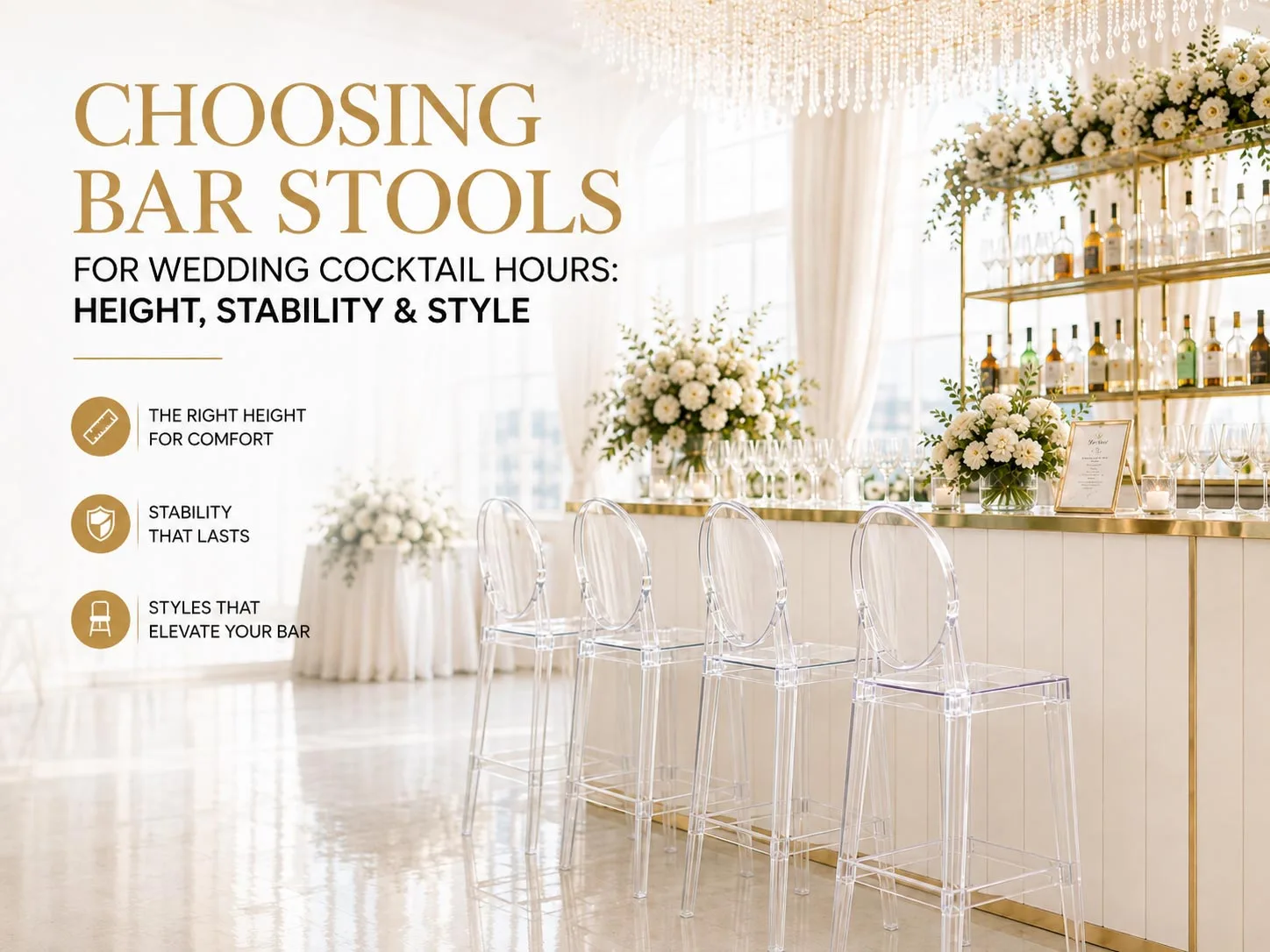
Wedding stools mostly split into two families. Metal-frame stools carry an upholstered seat. Clear acrylic “ghost” stools use that transparent oval-back look, which has more or less become the cocktail-hour default. Mostly because it disappears into whatever’s around it, instead of adding its own color to a room already full of florals, linens, and lighting.
Each type has its own soft spots.
Base footprint catches people off guard. A narrow four-leg base looks great in a catalog shot, but it tips more easily than a wider ring base or a weighted disc base once it hits carpet or an uneven floor — and event floors are rarely flat.
For the acrylic pieces specifically, the legs aren’t decoration sitting over a hidden frame. The legs are the frame. Thin or hollow-molded legs flex, and after enough use they go slightly cloudy right at the stress points, usually the joints. Solid acrylic through the leg and shelf joints simply lasts longer.
There’s also the footrest shelf. Most ghost-style stools mold this shelf in low, near the base, instead of using a separate metal rung the way an older stool design would. Check that it actually sits high enough to rest a foot on — some cheaper molds treat it as decoration, not function.
Ask about UV-stable resin too, since buyers skip this question often. Lower-grade acrylic yellows and fogs with enough sun exposure. If these stools will see any daylight — even filtered daylight through a tent — ask directly whether the resin is UV-stabilized. You can’t tell this from a photo.
And check the feet. Bare acrylic scratches marble and hardwood about as easily as bare metal, maybe more. Scuffed feet are usually the first part of the stool to go visibly cloudy, which feels like a waste given how much care usually goes into the rest of the piece.
Style choices that hold up under bar lighting
Backless, see-through stools photograph well and take up less visual space around a counter. That starts to matter once you’ve got thirty or more lined up for a larger event. An oval-back ghost stool works with almost any color palette, simply because it isn’t adding a color of its own to the mix.
The trade-off: scratches and haze show up far more on clear acrylic than they would on anything painted or upholstered. You just see it more.
Clarity matters more than most first-time buyers expect. Crisp, well-polished edges genuinely read as glass under warm event lighting. A stool from a cheaper mold — softer edges, a bit of frosting — reads noticeably lower-end the moment it sits next to candlelight and glassware. Even if nobody in the room could tell you exactly why it feels off.
Before you place the order
Ask whether the stools stack or nest. Non-stacking pieces eat up a surprising amount of warehouse and truck space once you’re running any real volume of rental inventory.
For acrylic pieces, ask how the supplier packs them. Acrylic chips and scratches in transit more easily than metal does, so pay for padded individual sleeves or crates. This isn’t the place to cut corners.
Skip abrasive cleaners. Micro-scratches from the wrong cloth build up fast, and a stool that started completely clear can go visibly hazy after just one season of careless wipe-downs. Specify a soft microfiber cloth and an acrylic-safe cleaner to whoever handles turnover between events — it’s a small ask that actually matters.
Order a few extras beyond your headcount, too. Other stations borrow stools during setup. Stools get moved around and occasionally chipped somewhere between the warehouse and the venue. A shortfall on the day, or a visibly damaged clear stool sitting in a photo backdrop, is much harder to explain away than most other furniture gaps.
Get the height right, and the base right, and the stool mostly disappears into the night. Nobody thinks about it. That’s the whole point. See the Bar Stool specs and request a quote here.