
Bar Furniture Sets: Building a Complete Mobile Wedding Bar Package
Most buyers source a bar counter, then a set of stools, then a cocktail table or two, then a display rack for bottles — four separate decisions, often weeks apart, sometimes from four different product pages. Each piece gets judged on its own merits. Then everything shows up at the same venue on the same night, and it either reads as one coordinated bar setup or as four things that happen to be standing near each other.
We’ve covered each of these pieces on its own — the counter, the stool, the cocktail table, the display rack — but a full mobile bar package has its own set of decisions that only show up once you’re trying to make four pieces function as one.
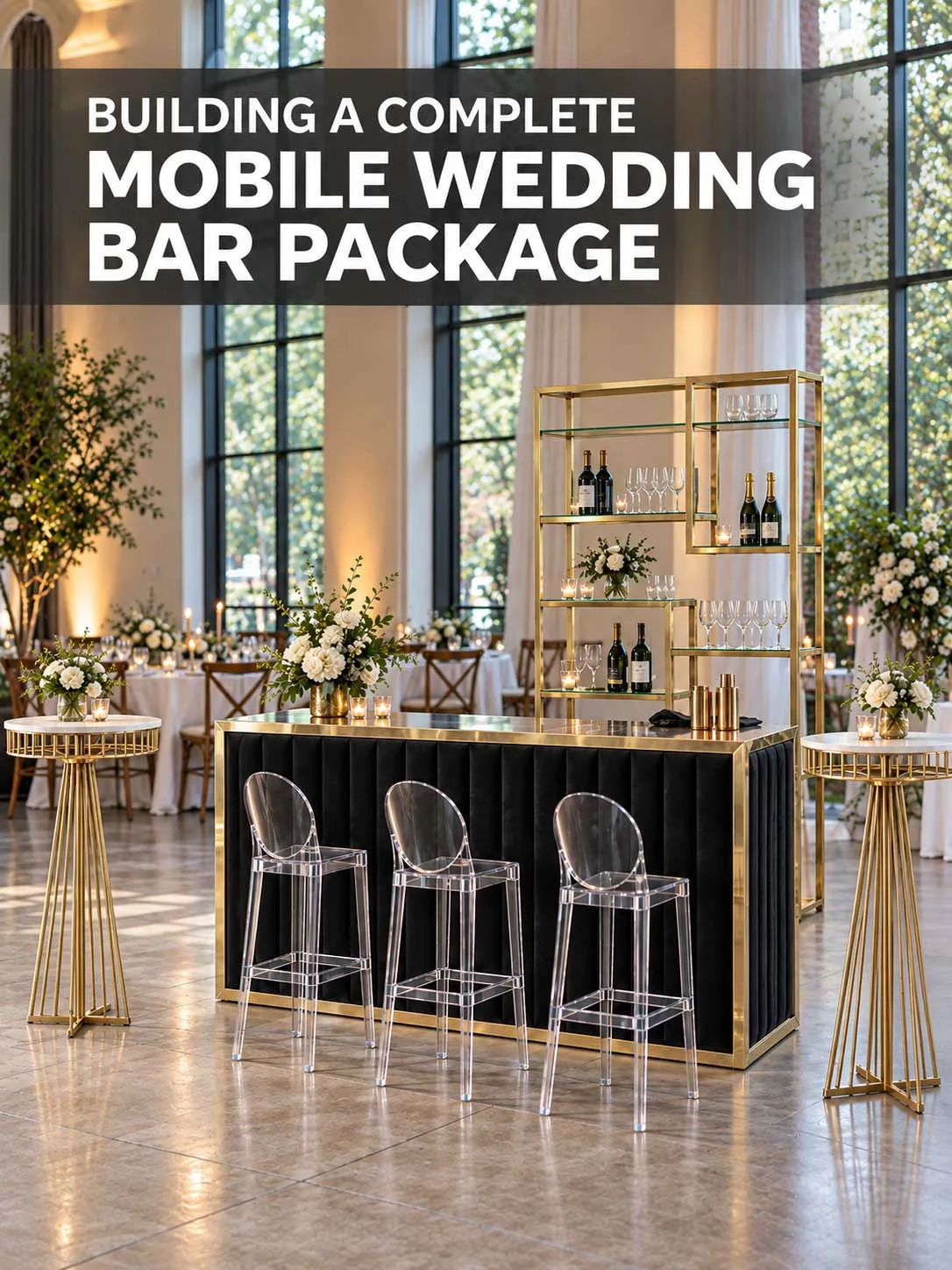
Height has to work across the whole package, not just pairwise
A bar counter and its stools need to match. So do the cocktail tables scattered through the room. What buyers miss is that these are actually two separate height systems doing two different jobs, and mixing them up reads as sloppy even when each pairing is individually correct.
The working bar — counter plus stools — runs at the height where a bartender pours and a guest sits to order. Standard counter height sits around 105-110cm with stool seats around 75- 80 cm underneath. The cocktail tables scattered through the rest of the room serve a completely different function: guests set a glass down while standing and talking, not sitting to be served. These typically match the same 105-110cm counter height as tabletop level, but since nobody sits at them, that’s the only height measurement that matters for that piece. Mixing up which pieces need seat-height coordination and which don’t is a surprisingly common ordering mistake.
One finish, sourced together, not matched after the fact
This is where a lot of otherwise well-planned bar setups fall apart under actual event lighting. “Gold” and “silver” aren’t single colors — they’re families of finishes that vary by supplier, by production batch, and sometimes within the same batch depending on plating consistency. A gold counter from one order and gold stools from a separate order can both be accurately described as gold and still look like two different metals once they’re standing three feet apart under warm lighting.
The fix is straightforward but easy to skip under time pressure: source the whole package — counter, stools, cocktail tables, and back-bar rack — from the same production run whenever the order size allows it. If that’s not possible, request physical swatches of every piece under the same lighting condition before committing to the full order, not just photos compared side by side on a screen.
Material consistency matters as much as finish
A package that mixes a stainless steel counter with clear acrylic stools works visually — we covered why in the material comparison piece — but it only works as an intentional choice, not an accidental one. If the plan is a fully steel package, check that the cocktail tables and display rack are actually the same grade of steel as the counter, not a lighter-gauge version that happens to look similar in a product photo. If the plan is a mixed material package, decide upfront which pieces carry visual weight (usually the counter and the back-bar rack) and which stay visually quiet (usually the stools and smaller cocktail tables), rather than letting the material mix happen by accident across separate purchase decisions.
Logistics change once you’re moving four piece types together
A single bar counter is one thing to load, transport, and set up. A full package multiplies that by four different footprints, four different weights, and four different assembly requirements, and this is where rental businesses running the same setup weekly actually feel the difference between a well-designed package and a collection of individually fine pieces.
Check whether each piece breaks down to a similar degree of complexity. A counter that knocks down flat but stools that ship fully assembled creates an uneven setup and breakdown timeline — someone’s standing around waiting on one piece while rushing another. Storage footprint matters here too: four pieces with wildly different stacking and nesting behavior eat far more warehouse space collectively than a package designed with consistent breakdown dimensions from the start.
Weight distribution across a delivery vehicle is worth planning for real orders. A stainless steel counter and a fully loaded back-bar rack both carry real weight, while stools and cocktail tables are comparatively light — loading a van without accounting for this imbalance is a small thing that becomes a real problem the first time a heavy piece needs to come out last but got loaded in first.
Ordering a package versus ordering pieces separately
For a one-off event, sourcing pieces individually from whatever’s available usually works fine, since a single night’s lighting and photography rarely exposes a subtle finish mismatch to anyone but the person who ordered it. For a rental business building reusable inventory, though, a coordinated package pays off across every event it’s used at, not just the first one — consistent finish and matched breakdown logistics compound in value every time the same pieces go out the door again.
If budget only allows building the package in stages, prioritize getting the counter and stools matched first, since that pairing sits closest together and any mismatch there is the most visible to guests standing at the bar. Cocktail tables and the back-bar rack have more visual distance from the counter and slightly more tolerance for finish variation before anyone notices.
Before you place a package order
Confirm whether the supplier can produce all four piece types from the same production batch, and ask directly rather than assuming — not every manufacturer handles bar counters, stools, cocktail tables, and display racks under one production line. Request a single finish swatch that represents the whole order, not one swatch per piece type. And ask for a combined breakdown and crating dimensions across the full package, since freight and storage planning works differently for four coordinated pieces than for four separate purchases.
Get the height systems, the finish, and the logistics aligned across all four pieces, and a mobile bar package reads as one designed setup instead of four separate purchases that happened to end up in the same room. Browse the full Bar Furniture range and build a matched package here.