
The headcount is the easy part. A couple says “150 guests,” and it sounds like a number you can just multiply. Then the order goes in, the day arrives, and somehow there are 12 chairs too few at the ceremony and a dead corner full of stacked tables at the reception. Chair counts go wrong because a wedding isn’t one seating event. It’s three or four, and each one runs on different math.
Start by splitting the day into seating moments
Most weddings have a ceremony, a cocktail hour, a seated dinner, and sometimes a lounge or after-party. Guests don’t sit the same way in each, so the same 150 people need very different furniture counts across the day.
Treat each moment as its own calculation. Then check which pieces can be reused between them, because a good plan moves chairs from the ceremony to the lounge instead of ordering twice.
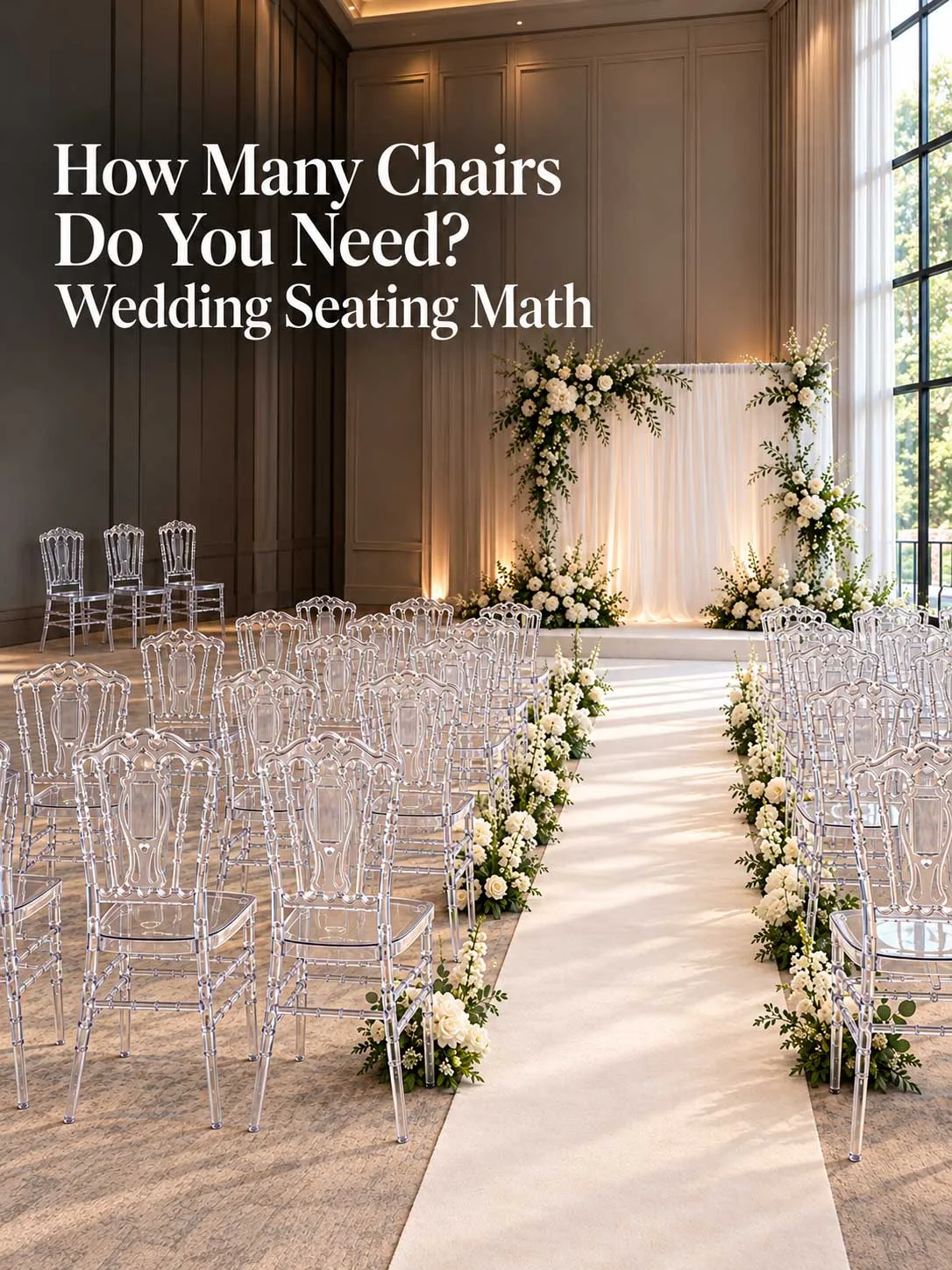
Ceremony: one chair per guest, plus a cushion
This one is simple. Everyone sits, so you need one chair per guest. Add a buffer of roughly 5 to 10 percent for late additions, plus-ones nobody mentioned, and elderly guests who want a spot near the aisle. For 150 guests, that’s about 158 to 165 chairs.
Space matters as much as count. Ceremony seating runs tight, around 0.6 to 0.75 square meters per guest including aisles. Leave an aisle at least 1.2 meters wide so a dress and a photographer can both fit. If you squeeze rows too close, the chair count looks fine on paper and the room feels cramped in person.
Cocktail hour: fewer seats than people think
Here’s where overordering happens. Cocktail hour is mostly standing, and guests move around. Planners usually seat only 30 to 50 percent of guests during this window, mainly older relatives and anyone who needs a break.
For 150 guests, that means somewhere between 45 and 75 seats, spread across stools, lounge seating, and a few regular chairs near the bar. Put the rest of your budget into standing tables instead. A rough ratio is one cocktail table per 8 to 10 standing guests, which we cover in more detail in our cocktail table sizing guide. For the bar itself, matching your stool height to the counter matters more than the raw stool count.
Seated dinner: tables first, then chairs
For dinner, work from tables, not guests. Round tables are the usual choice, and the seating depends on the diameter:
- A 1.5 meter round seats 8 to 10 comfortably.
- A 1.8 meter round seats 10 to 12.
- Rectangle banquet tables vary, but figure about 60 to 70 centimeters of table length per guest.
Divide your headcount by the seats per table, then round up. For 150 guests at tables of 10, that’s 15 tables. Add one more if there’s a separate sweetheart table or head table, and don’t forget kids’ tables or a vendor table for the photographer and DJ, since those people usually eat too.
Chairs come straight from the table count. Fifteen tables of 10 is 150 chairs, plus the buffer. A spare of 5 percent is enough here, since dinner seating is fixed and guests rarely wander off with chairs the way they do at a cocktail hour.
Room size decides whether the math actually works
You can calculate perfect numbers and still run out of floor. A rough rule for a seated dinner is 0.9 to 1.1 square meters per guest. If there’s a dance floor, plan closer to 1.4 square meters per guest, because the floor itself eats a big chunk of the room.
Check this before you finalize anything. If the venue gives you 120 square meters and you’re seating 150 with a dance floor, something has to give. Usually it’s either the dance floor size or the table count, and it’s much cheaper to find that out on paper than the week of the event.
A quick worked example
Take 150 guests, a ceremony, a cocktail hour, and a seated dinner in a single ballroom:
- Ceremony: 150 guests plus about 8 percent buffer, so roughly 162 chairs.
- Cocktail hour: seat 40 percent, so about 60 stools and lounge seats, plus 15 to 19 cocktail tables.
- Dinner: 15 tables of 10, plus one sweetheart table, so 16 tables and around 158 chairs including spares.
Notice the ceremony chairs can often become the dinner chairs after the room flips. That’s why chair counts across the day don’t just add up. If your venue can’t flip the room quickly, you may need both sets, and that’s worth knowing before the quote comes back.
Where people usually get it wrong
A few mistakes show up again and again. People forget to count the head table, the DJ, the photographer, and the kids’ table. They order exactly the headcount with no spares, then lose chairs to damage and last-minute guests. They also assume the same chair works everywhere, when a bar stool, a ceremony chair, and a dinner chair have completely different height and comfort needs. We cover that last one in our guide on matching chairs to table bases.
And sometimes people count correctly but ignore the space. A full set of chairs that doesn’t fit the room is just a very expensive storage problem.
Before you finalize the order
Write down the headcount for each seating moment separately. Add your buffer to the ceremony and dinner numbers. Check the floor area against the venue’s actual dimensions, not the brochure. And confirm which pieces can move between moments, since that’s where most of the savings hide.
Do the math in that order and the chair count stops being a guess. If you’re building out an inventory instead of one event, browse our full catalog and price out the core pieces first.