
Renting vs Buying Wedding Furniture: A Cost Breakdown for Event Businesses
Every event business runs the same calculation eventually, usually after turning down a booking because the right chairs weren’t available. Keep renting from a local supplier for each event, or buy inventory outright and stop depending on someone else’s availability. The answer isn’t the same for every business, and the usual advice — “buy once you’re doing enough volume” — skips over most of the actual math.
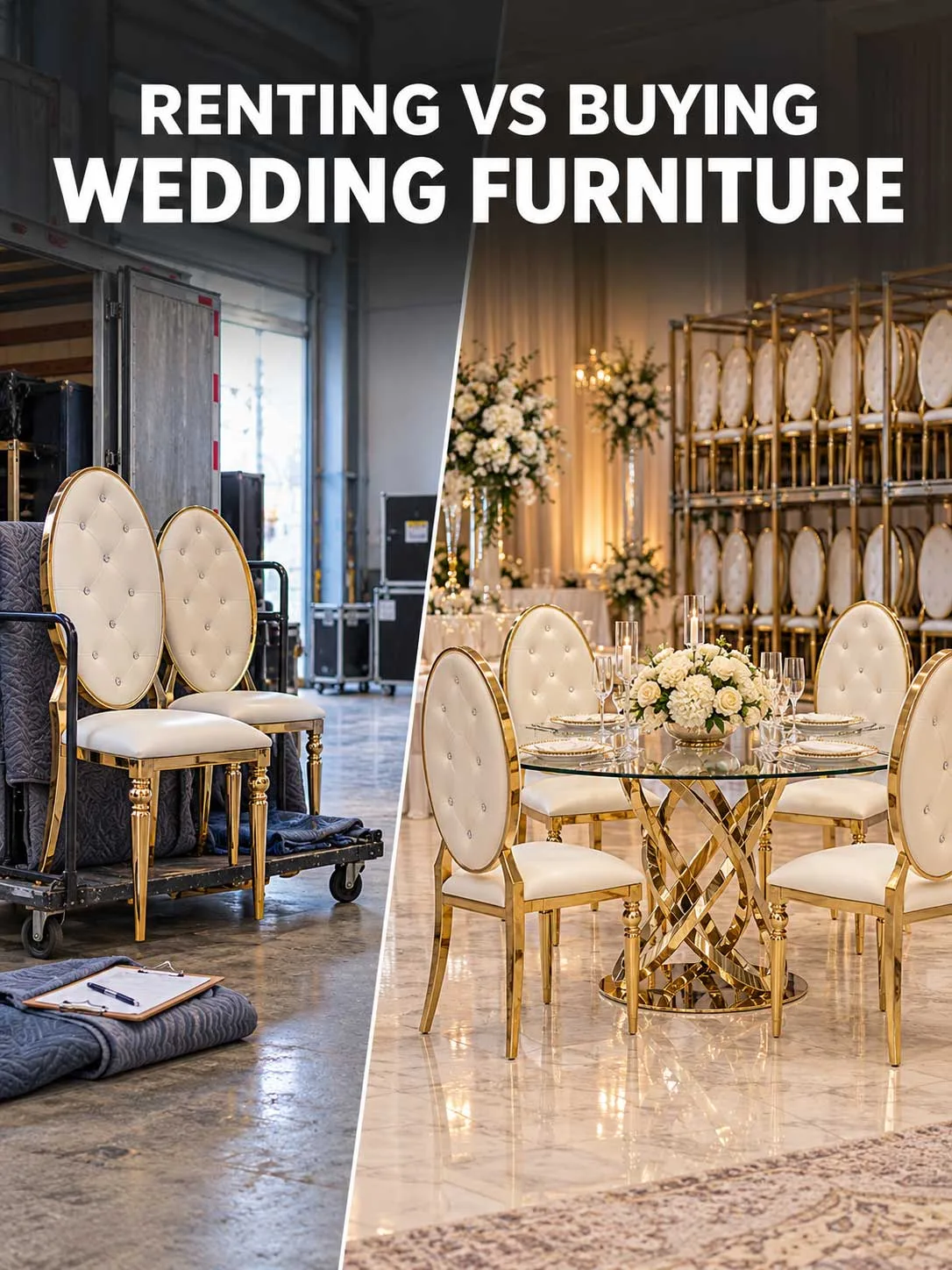
What renting really costs over a year
Renting looks cheap per event because the line item is small and predictable. A single wedding might cost a few hundred dollars in furniture rental fees, and that number is easy to quote to a client without thinking much further than the next booking.
The real cost shows up in volume. A business running 20 weddings a year at even a modest rental fee per event is paying a recurring cost that, within two to three years, often exceeds what the same furniture would have cost to buy outright — without the business ever owning anything at the end of it. Rental also comes with availability risk baked in: during peak wedding season, the exact pieces a client wants are the same pieces every other local business wants, and a supplier’s inventory runs out exactly when demand is highest.
What buying actually costs, beyond the invoice
The upfront number for buying inventory is obviously larger, and that’s where most of the hesitation comes from. But the invoice total isn’t the complete cost picture. Owned furniture needs somewhere to live between events — warehouse or storage space that has its own monthly cost, which rental businesses sometimes forget to add into the comparison because it feels like a separate expense rather than part of the furniture decision.
Transport is a real cost too, whether buying or renting, but it compounds differently when you own the inventory. A rental supplier typically handles delivery as part of their fee. Owned furniture needs a business’s own delivery logistics — a van, a driver, insurance on goods in transit — which is a fixed cost whether the inventory gets used once a month or every weekend.
Maintenance and depreciation are the costs that are easiest to underestimate going in. Furniture that gets loaded, transported, set up, and broken down every weekend wears differently than furniture used occasionally. Upholstery fades and tears, finishes scratch, and parts need occasional replacement — none of which shows up on the purchase invoice, but all of which affects the real cost of ownership over several years.
The break-even point depends more on usage than on price
The simplest way to think about this: divide the furniture’s purchase price by the rental fee you’d otherwise pay per use. A set of stainless steel bar stools costing a certain amount to buy outright, compared against what a supplier would charge to rent the same stools for one weekend, gives a rough number of events before ownership becomes cheaper than continuing to rent.
That math changes fast with usage frequency. A piece used for 2-3 events a year rarely justifies the upfront cost, storage space, and maintenance burden of ownership — renting stays the better option almost indefinitely at that volume. A piece used 15-20+ times a year usually crosses the break-even point within one to two years, after which every additional use is close to pure margin compared to the ongoing cost of renting the same thing repeatedly.
The pieces worth owning first are usually the ones that get used at nearly every event regardless of styling — standard chairs, basic cocktail tables, core bar furniture. The pieces worth continuing to rent are the ones that vary heavily by client request — a specific color trend, a statement piece requested for one wedding and unlikely to suit the next.
Quality differences that don’t show up in a simple cost comparison
Rental inventory, by necessity, gets shared across many businesses and events, which means it’s often built to survive volume rather than to look flawless in every photo. Scuffs, minor finish inconsistencies, and wear accumulate faster on shared rental stock, and a business renting the same pieces repeatedly has no control over the condition those pieces arrive in for any given event.
Owned furniture, sourced directly and maintained by one business, tends to hold a more consistent appearance over time, simply because there’s direct control over storage, cleaning, and repair rather than depending on whatever condition a rental supplier’s previous client left it in. For a business building a visual brand around consistent, photo-ready furniture, this consideration sometimes outweighs the pure cost math.
A hybrid approach works for most growing businesses
Few businesses need to choose one model exclusively. A common pattern: own the core, high-frequency pieces — the chairs and tables that appear at nearly every event — while continuing to rent specialty or trend-driven pieces that would sit unused in storage most of the year if purchased outright.
This hybrid approach also smooths out the biggest risk of buying everything upfront: committing capital to inventory before knowing which specific styles and pieces actually get requested most often. Starting with core pieces, tracking which rented items get requested repeatedly over a season or two, and gradually buying into those specific categories reduces the risk of ending up with owned inventory that doesn’t match actual client demand.
What to actually calculate before deciding
Work out the real annual cost of continuing to rent the specific pieces used most often, including the risk cost of unavailability during peak season. Separately, calculate the full cost of owning those same pieces — purchase price, storage, insurance, transport, and a realistic maintenance budget, not just the invoice total. Compare the two over a three-year horizon rather than a single event or a single year, since the first year of ownership often looks worse on paper than it does once the break-even point is actually reached.
Neither renting nor buying is the automatically right answer. It’s a volume and cash-flow question specific to each business, and the businesses that get this calculation wrong are usually the ones that only ran the comparison for one year instead of three. Browse the full Feidao Furniture catalog to price out what owning your core pieces would actually cost.